


For foreign investors operating in China, adjusting corporate structure, such as changing the legal representatives and shareholders of Chinese companies, is a common requirement for business expansion, leadership restructuring, or ownership transfer. While China’s regulatory framework for corporate changes is well-defined, foreign applicants often face unique challenges related to document authentication, industry access restrictions, and cross-border compliance. Per China’s Company Law, all changes to legal representative or shareholder information must be formally registered with government authorities to be legally valid, and unregistered changes can result in operational restrictions, fines, or disputes with third parties. This step-by-step guide is tailored specifically for foreign applicants, outlining all eligibility requirements, required paperwork, and compliance rules to complete the process smoothly.
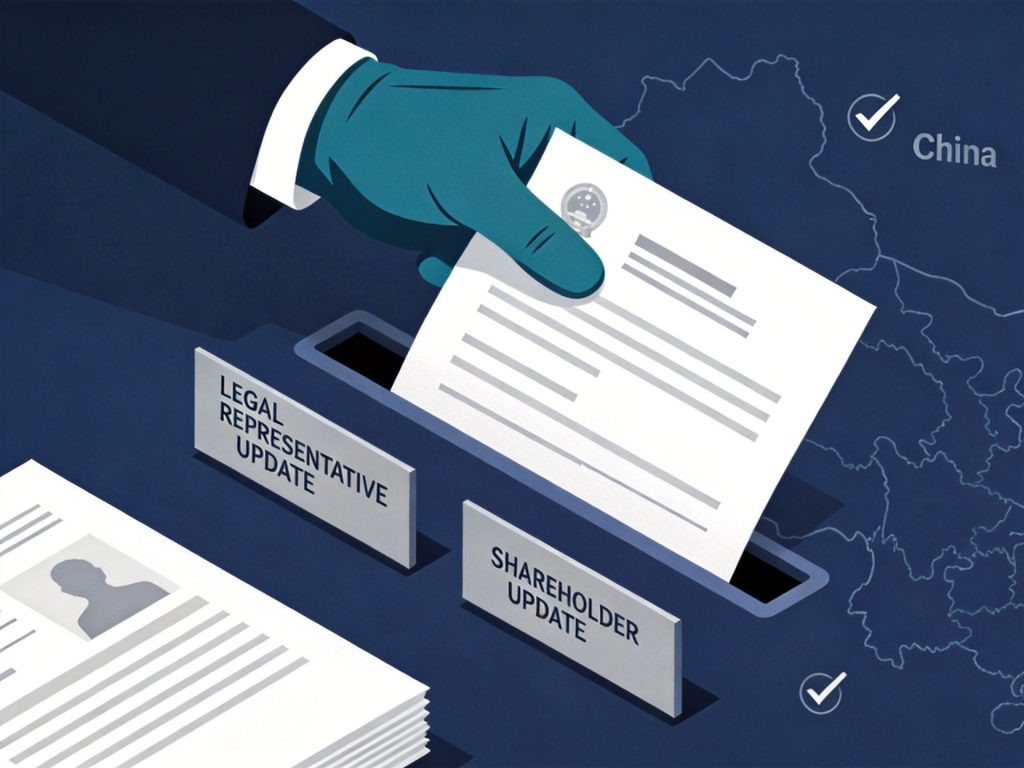
Step 1: Changing legal representatives or shareholders: Confirm Eligibility and Pre-Change Compliance
The first step for foreigners changing legal representatives or shareholders of Chinese companies is verifying that all parties and the proposed changes meet official eligibility criteria. Per regulations from the China Ministry of Commerce, there are no nationality restrictions for legal representatives of Chinese companies, so foreign nationals are fully eligible to hold this position as long as they have no record of serious administrative or criminal violations in China. For shareholder changes, you will first need to confirm that the company’s industry is not listed on the National Development and Reform Commission’s 2024 Negative List for Foreign Investment; if the industry is restricted or prohibited for foreign investment, adding a foreign shareholder will require additional special approval or may not be permitted. You will also need to secure written approval from at least two-thirds of existing shareholders per the company’s articles of association, and confirm that the company has no outstanding tax debts, unpaid administrative fines, or pending legal disputes that would block registration changes.
⚠️ Risk Warning: If the outgoing legal representative is listed as a person responsible for unpaid taxes or regulatory violations, you will need to resolve these issues before submitting the change application, as authorities will reject applications for companies with unresolved non-compliance records.
Once you have confirmed all eligibility requirements are met, you can proceed to prepare the required official documentation.
Step 2: Prepare Notarized and Authenticated Application Documents
Foreign applicants are required to submit authenticated identity and corporate documents to verify the legitimacy of the changes, as unnotarized foreign documents are not recognized by Chinese regulatory authorities. The core required documents include:
- For new foreign legal representatives: Notarized copy of valid passport, with notarization completed at the Chinese embassy or consulate in the applicant’s home country, plus a signed appointment letter and resume
- For shareholder changes: Signed share transfer agreement, notarized identity proof of new foreign shareholders, proof of capital contribution (if applicable), and a statement confirming no related party transactions that violate anti-monopoly rules
- Internal corporate documents: Official shareholder resolution approving both changes, updated version of the company’s articles of association, resignation letter from the outgoing legal representative, and a signed power of attorney if you are appointing a third party to submit the application on your behalf
All documents written in a foreign language must be translated by a translator certified by Chinese authorities, with the translation affixed with the translator’s official seal. Once all documents are fully prepared, you can submit your application to the local Administration for Market Regulation (AMR).
Step 3: Submit Application to Local Administration for Market Regulation
You can submit your application for changing legal representatives and shareholders of Chinese companies either in person at the local AMR office or via the official online AMR service platform for your city. If you are not physically present in China, you can appoint a licensed corporate service provider or legal representative to submit the application on your behalf, as long as you provide a signed and notarized power of attorney. The AMR will review your documents within 3-5 working days, and if no corrections are required, you will receive an updated business license reflecting the new legal representative and shareholder information within 7 working days total.
Tip: Many first-time foreign applicants face rejection due to minor errors in document formatting or missing authentication stamps, so it is recommended to have a local professional review your documents before submission to avoid delays.
After receiving your updated business license, you will need to update your registrations with other government departments to remain fully compliant.
Step 4: Update Tax and Social Security Registrations
Per regulations from the State Taxation Administration, all companies must update their tax registration information within 30 days of receiving an updated business license, including changes to the legal representative or shareholder structure. To complete this step, you will need to submit a copy of the updated business license, the shareholder change resolution, and the new legal representative’s identity proof to your local tax bureau. You will also need to update your company’s social security and housing fund registrations, as the legal representative is the officially responsible party for employee benefit contributions.
Failure to complete tax registration updates within the 30-day window can result in administrative fines ranging from RMB 1,000 to RMB 10,000, and may restrict your company’s ability to issue fapiao (official tax invoices) or apply for tax refunds. Once you have completed all government registration updates, you will need to adjust your internal corporate records and banking information.
Step 5: Update Corporate Bank Accounts and Official Seals
Changing your company’s legal representative requires updating all bank account records, as the legal representative is the primary signatory for all corporate banking transactions. You will need to visit your company’s account opening bank in person (or appoint an authorized representative) with the updated business license, new legal representative’s passport, and shareholder change documents to update the signature on file, contact information, and shareholder records. You will also need to have a new official legal representative seal engraved at a government-licensed seal provider, and update the company’s official seal and financial seal if the ownership change requires it.
It is also recommended to notify all key business partners, suppliers, and clients of the changes to avoid disruptions to payment processes or contract execution. Once all banking and seal updates are complete, you can conduct a final compliance check to confirm all records are accurate.
Step 6: Conduct Post-Change Compliance Verification
The final step for foreigners changing legal representatives and shareholders of Chinese companies is verifying that all public and internal records reflect the updated information correctly. First, check the National Enterprise Credit Information Publicity System (NECIPS) to confirm that the new legal representative and shareholder details are published publicly, as this is the official record that third parties will reference for contract negotiations or due diligence checks. If your company holds any special industry licenses, such as an import/export license, ICP license, or food operation license, you will need to update these licenses with the new legal representative information to avoid operational restrictions.
You should also update all internal company materials, including contract templates, official letterheads, invoice information, and website footer details, to reflect the new leadership and ownership structure. Completing these final checks will ensure your changes are fully legally valid and eliminate the risk of future disputes or compliance issues.
Conclusion:
Changing legal representatives and shareholders of Chinese companies as a foreign investor is a structured, transparent process when you follow official regulatory requirements and properly authenticate all required documents. While the process can be completed independently, many foreign applicants choose to work with a licensed corporate service provider to navigate document authentication requirements, industry access checks, and submission processes to minimise delays and avoid compliance errors. By following the steps outlined in this guide, you can complete your corporate structure changes efficiently and keep your Chinese business fully compliant with local laws.
