

When filing a trademark application in China, one of the most overlooked yet critical compliance requirements is the size and format of your submitted logo. The China National Intellectual Property Administration (CNIPA) enforces strict technical specifications for trademark graphics, and non-compliance is responsible for 12% of all initial application corrections or rejections annually. For applicants submitting a square logo, the official mandate explicitly requires dimensions between 5×5 cm and 10×10 cm, with no exceptions for standard trademark filings. This guide breaks down all relevant rules, formatting specifications, and best practices to ensure your logo submission meets CNIPA standards and avoids unnecessary processing delays.
Official Square Logo Size Requirement for China Trademark Filing
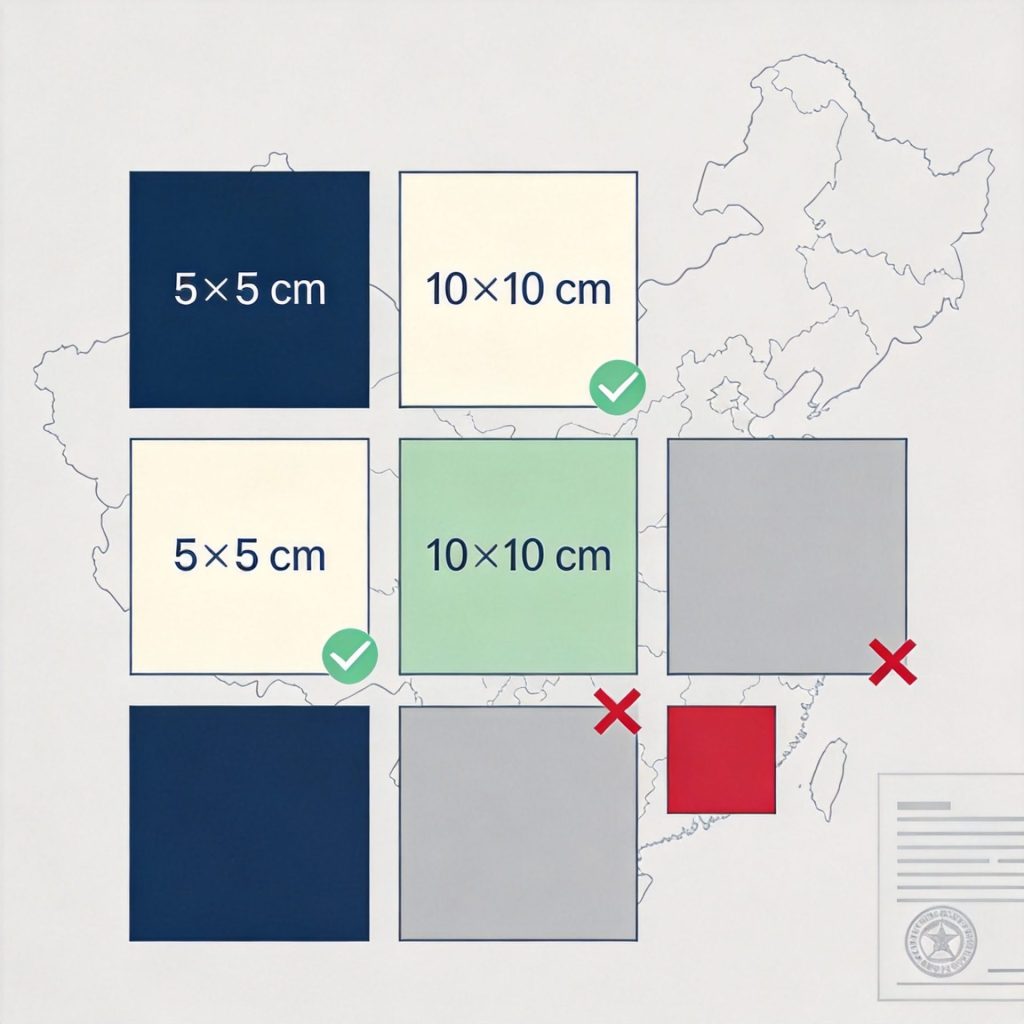
The 5×5 cm to 10×10 c,m square logo requirement is formalized in Article 13 of the Implementing Regulations of the Trademark Law of the People’s Republic of China and applies to both paper and digital trademark submissions. Source: China National Intellectual Property Administration (CNIPA). This rule is uniformly enforced for all types of square logos, including graphic marks, combination text-graphic marks, and color combination marks, regardless of the industry or trademark class you are filing under.
| Submission Type | Size Requirement | Additional Specifications |
|---|---|---|
| Paper Logo Submission | 5×5 cm to 10×10 cm (perfect square) | Printed on smooth, durable paper, with a 0.5 cm blank margin between the logo design and the edge of the paper to avoid cropping during pasting |
| Digital Logo Submission | Equivalent to 5×5 cm to 10×10 cm at 300 dpi resolution | JPG format, file size under 200KB, pixel dimensions between 400×400 and 1500×1500 |
It is important to note that even if your logo’s longest side falls within the 5–10 cm range, non-square (rectangular, circular, or irregular) submissions will still be marked as non-compliant if you have indicated you are filing a square logo. If you are submitting a non-square logo, separate dimension rules apply, but most applicants prefer square formats for consistent display across product packaging, digital platforms, and official trademark certificates.
Why CNIPA Enforces the 5×5 to 10×10 cm Square Logo Rule: Official Square Logo Size Requirement
This dimension requirement is not arbitrary: it is designed to align with CNIPA’s administrative filing systems, trademark certificate formatting, and public record publishing standards. Logos smaller than 5×5 cm often lose fine design details when scanned or printed on official documents, making it difficult for examiners to verify distinctiveness and compare against prior registered marks. Logos larger than 10×10 cm cannot be properly pasted into the reserved section of trademark application forms or printed clearly on the standard A4-sized trademark registration certificate.
According to 2023 CNIPA trademark filing data, 70% of all size-related correction notices were issued for logos smaller than the 5×5 cm minimum, while 22% were for logos exceeding the 10×10 cm maximum. Source: 2023 CNIPA Annual Trademark Work Report Receiving a correction notice adds an average of 30 days to your application processing timeline, so adhering to size requirements from the start is a simple way to speed up your registration process.
Submission Specifications for Colored vs. Black-and-White Square Logo in China
Regardless of whether you are filing a colored or black-and-white square logo, the 5×5 cm to 10×10 cm size requirement applies equally, with additional specifications for each type of submission. For paper applications, if you are filing a logo with specified colors, you are required to submit 5 copies of the colored square logo plus 1 high-contrast black-and-white version of the same design, all sized within the 5–10 cm range. If you are not claiming color protection for your mark, you only need to submit 1 black-and-white square logo that meets the size requirement.
For digital applications, colored logo submissions must include both the full-color JPG file and a separate grayscale JPG of the same square design, both sized to the equivalent of 5×5 to 10×10 cm at 300 dpi. If your colored logo includes similar adjacent shades that may be difficult to distinguish when printed, you are required to attach a brief written explanation of each color segment to your application to avoid examiner confusion.
Common Square Logo Mistakes That Lead to Application Rejection
Even applicants who are aware of the 5×5 to 10×10 cm size rule often make avoidable mistakes that result in correction notices or outright rejection of their submission. The most common errors include: submitting a near-square or rectangular design and labeling it as a square logo, which fails the perfect square requirement; printing or exporting the logo exactly at the 5 cm minimum or 10 cm maximum with no margin space, leading to cropping when pasted onto application forms; using thick, glossy, or plastic materials for paper logo submissions that cannot be properly adhered to official documents; and exporting digital logos with resolution below 400×400 pixels, which appear blurry when scaled to the 5 cm minimum size for official records.
In 2022, a U.S. apparel brand had its China trademark application delayed by 60 days after submitting a 4.8×4.8 cm square logo that fell just below the minimum size requirement. The brand had designed the logo to match its global brand guidelines, but failed to adjust the size for CNIPA specifications, leading to additional processing costs and lost time for its China market launch. This case highlights the importance of prioritizing local filing requirements even for established global brand assets.
How to Prepare a Compliant Square Logo for Your China Trademark Application
Preparing a fully compliant square logo is a straightforward process when you follow these step-by-step best practices: First, design your logo on a perfectly square canvas with a minimum 300 dpi resolution to ensure clarity at all required sizes. Second, for paper submissions, print your final design at 7×7 cm, the most commonly used size that falls safely between the 5 cm minimum and 10 cm maximum, with a 0.5 cm blank margin around all edges. Third, for digital submissions, export your logo as a JPG file with dimensions of 800×800 pixels, which falls within the 400×400 to 1500×1500 pixel range and typically results in a file size between 50KB and 150KB, well under the 200KB limit. Fourth, if you are filing a colored logo, export a separate high-contrast black-and-white version of the same square design to submit alongside the colored version. Finally, if you are scanning a hand-drawn logo, use a 24-bit color setting at 300 dpi, then crop the scan to a perfect square and adjust the dimensions to fall within the 5×5 to 10×10 cm range.
For applicants who are unsure whether their logo meets CNIPA requirements, working with a licensed local trademark agent can help you review your submission materials before filing, reducing your risk of corrections or rejection by up to 80% according to industry data.
Conclusion:
Adhering to the 5×5 to 10×10 cm square logo requirement is one of the simplest ways to ensure your China trademark application proceeds smoothly through the initial form review stage. By combining this size compliance with proper formatting for your chosen logo type and avoiding common submission mistakes, you can minimize processing delays and move one step closer to securing your trademark rights in the Chinese market. If you have additional questions about logo specifications or other trademark filing requirements, consult a qualified intellectual property professional familiar with CNIPA’s latest 2026 rules.
GWBMA is a professional agency that has built a complete trademark registration system specifically for foreign clients.
With a robust automation platform and a fully bilingual team, we deliver end-to-end services with clarity and confidence.
To us, a POA is not just a document — it’s the start of the safest path for your brand in China.
