


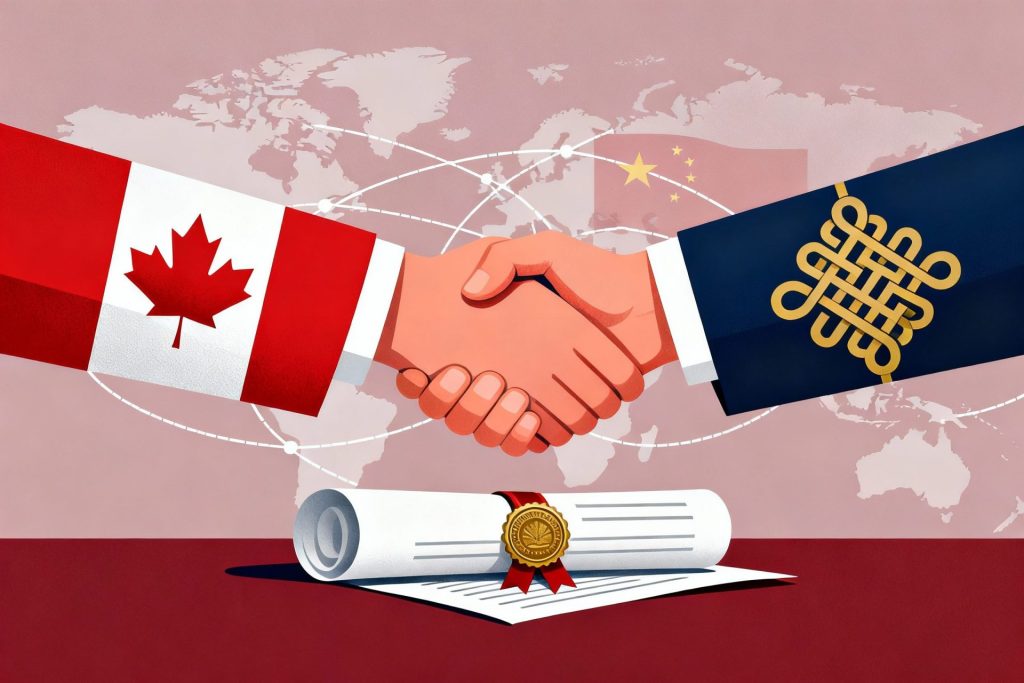
From January 14 to 17, 2026, Beijing welcomed its first high-level guest from Ottawa in eight years: Canadian Prime Minister Mark Carney has visited in China. This was more than just a flight across thousands of miles; it was a political “Long March” across seven years of diplomatic permafrost.
As US-Canada trade friction escalates and Washington threatens universal tariffs, the Canadian PM’s visit to China serves as more than an economic lifeline. It is a declaration to the world: Canada is no longer a satellite state of any superpower. A former central banker, the Prime Minister is using cold, calculated economic logic to find a new strategic anchor for Canada amidst the widening cracks in North America.
I. Key Data: A Report Card for “Back on Track”
During the visit, both nations signed the landmark “China-Canada Economic and Trade Cooperation Roadmap.” This is no longer hollow rhetoric but a concrete exchange of interests. Canada understands that diplomatic leverage stems from economic resilience.
【Table 1: Key Breakthroughs in China-Canada Economic Cooperation】
| Core Indicators | New Status (January 2026) | Estimated Economic Impact |
| Diplomatic Gap | First visit in nearly 8 years | Symbolizes full normalization of relations |
| EV Tariffs | Reduced from 100% to 6.1% (within quota) | Lowers average EV cost for Canadians by ~15% |
| Agricultural Access | Full restoration of Canola, Lobster, Timber, and Beef | Deals exceeding CAD $4.5 Billion |
| Energy Agreement | 5-year LNG (Liquefied Natural Gas) supply deal | Diversifies energy exports; reduces US dependency |
| Flight Frequency | Increased to 84 flights per week (Cargo/Pax) | Logistics costs ↓ 30%; Airfare ↓ 25%-35% |
II. Economic Breakthrough: From Friction to “Win-Win”
The most significant outcomes of the Canadian PM’s visit to China were in the economic sphere. Addressing the tariff disputes of recent years, both sides showed immense flexibility to prioritize pragmatic growth.
- The Trade Roadmap Design: The signing of this document upgrades the Joint Economic and Trade Committee to a Ministerial Level. It sets a clear blueprint for cooperation in green energy, digital trade, and supply chain resilience over the next decade.
- The EV & Agriculture “Grand Bargain”: In the most talked-about deal of the trip, Canada agreed to allow up to 49,000 Chinese EVs at a 6.1% Most Favored Nation (MFN) tariff (down from 100%). In response, China lowered tariffs on Canadian Canola and restored market access for premium seafood and agricultural products. This move effectively breaks the North American trade blockade.
- Rebooting Energy Dialogue: The two nations resumed the Ministerial Energy Dialogue, focusing on green energy and critical minerals. Canada aims to export LNG via the Pacific route—bypassing US pipelines—while exploring joint ventures in mineral processing.
III. The US-Canada Rift: Turning Away from the “Big Brother’s” Stick
This historic visit took place against a backdrop of “US-Canada Estrangement.” Since 2025, Washington’s aggressive protectionist policies have pushed the Canada-US border into unprecedented tension.
- The “Betrayal” by Washington: Washington has not only threatened “National Security Tariffs” on Canadian oil but has also attempted to use USMCA review clauses to restrict Canada’s free trade negotiations with third parties. This “suzerain-like” arrogance has deeply frustrated Ottawa.
- The PM’s Counter-Strike: Facing US pressure, the Prime Minister displayed high economic rationality. In Beijing, he stated: “Canada’s prosperity cannot be tied to a single safety rope.” By opening the market to Chinese EVs, he is signaling to Washington that Canada has the right to choose reliable, cost-effective partners.
- The Logic of Survival: For Canada, rather than suffocating in a North American trade war, it is far more logical to hedge risks by tapping into China’s massive middle-class market. This “de-dependency” move is both bold and strategic, marking a shift from “follower mode” to “sovereign mode.”
IV. Observation: Why Now? Why “Look East”?
As a Harvard and Oxford-educated elite who led both the Bank of Canada and the Bank of England, the current PM is “results-oriented.” He understands that in the 2026 global arena, ideological fervor must eventually yield to economic reality.
“This is a cold-blooded mitigation of loss and a bold bet on the future.”
Seven years ago, China-Canada relations plummeted due to external interference. Seven years later, the Canadian PM chose to knock on the door with pragmatism. This reflects an awakening in Canadian politics: as a sovereign nation, its national interests should not be repeatedly sacrificed in the gambits of other powers.
V. People-to-People Bonds: Diplomacy Beyond Numbers
To further solidify public support, the Canadian PM announced a landmark development in Beijing: China will implement a unilateral visa-free policy for Canadian citizens.
【Table 2: Facilitation Measures for People-to-People Exchange】
| Policy Item | Implementation Details | Beneficiary Group & Impact |
| Visa-Free Entry | 30-day visa-free entry for Canadian passport holders | Business travelers, tourists, and family visits |
| 10-Year Visa Reinstatement | Full recognition of existing 10-year multi-entry visas | Stability for long-term family and business ties |
| Education Restart | Reopening the Scholars Exchange with 2,000 spots | Rebuilding ties between youth and academia |
| Aviation Rights | Resumption of multiple daily flights to major hubs | Reduced travel costs and increased accessibility |
With China’s announcement of a 30-day unilateral visa-free policy for Canadian citizens, the barrier to entry for Canadian entrepreneurs has dropped to an all-time low. This development creates a “Green Channel” for Canadian brands looking to establish a physical presence in China.
The 30-day visa-free window provides immense convenience for Canadian investors to conduct on-site inspections, sign corporate legal documents, and handle bank account openings in person. Canadian companies can now accelerate the incorporation of a WFOE (Wholly Foreign-Owned Enterprise) within China. This allows them to achieve fully independent operations, issue local invoices (Fapiao), and directly hire local staff—effectively transitioning from “offshore traders” to “localized market operators.”
Navigating the legalities of WFOE formation requires professional oversight. GWBMA offers a comprehensive suite of services to ensure that as your business enters the market, your Company Registration and IP Services are fully protected under Chinese law, mitigating any risk of intellectual property theft.
VI. Conclusion: Not Just “Hello,” But “We Are Walking Our Own Path”
At the departure press conference, the Prime Minister made it clear: “The freezing point of geopolitics should not be paid for by ordinary citizens and businesses.”
This Canadian PM’s visit to China has brought back more than just tens of billions in potential orders; it has restored the dignity Canada deserves as a sovereign player in a multipolar world. For China-Canada relations, January 2026 is a milestone; for a North American economy struggling with internal rifts, it may be the final “lifeboat.”
