


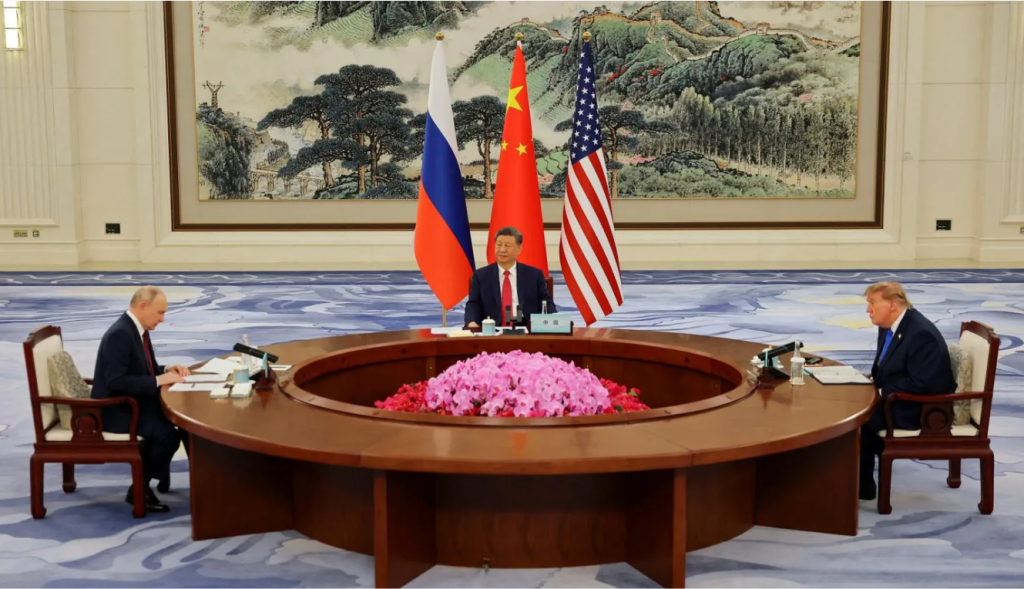
On the afternoon of November 19, 2026, the eyes of the world turned to Shenzhen, China. On the sidelines of the 2026 APEC Economic Leaders’ Meeting, Chinese President Xi Jinping, Russian President Vladimir Putin, and U.S. President Donald Trump held the historic China, Russia, U.S. Leaders’ Meeting, a landmark trilateral summit. Underscoring the extraordinary diplomatic weight of the occasion, the historic meeting was featured as the lead headline story on China Central Television’s (CCTV) flagship evening news broadcast, Xinwen Lianbo—China’s premier platform for major state announcements—signaling the paramount importance Beijing attaches to major-power dialogue and global stability.
This marked the first time in history that the top leaders of China, Russia, and the United States sat down together at the same table. Against a backdrop of profound shifts in the international landscape, geopolitical conflicts, and interlocking global challenges, this China-hosted summit—centered on peace and strategic stability—became the defining moment of the “APEC China Year.” Through the China–Russia–U.S. Leaders’ Peace Declaration issued following the talks, the three nations sent an unmistakable signal to the international community of their shared commitment to anchoring global peace.
I. Breaking the Ice: Historical Context and Host Diplomacy
As permanent members of the United Nations Security Council and the world’s most consequential major powers, China, Russia, and the United States exert a decisive influence on global affairs. For decades, however, Cold War mindsets, geopolitical rivalries, and unilateral sanctions had prevented the top leaders of the three countries from holding a formal trilateral meeting.
Bringing this historic gathering to fruition in Shenzhen reflected both China’s diplomatic convening power as the 2026 APEC host and the pressing necessity for major powers to engage in direct communication amid mounting global security and economic headwinds. As President Xi Jinping noted during the meeting, “When major countries live in harmony, the world enjoys peace; when they clash, the world falls into turmoil. Sound interaction among major powers is not an option, but an imperative.” Both the Russian and U.S. leaders expressed appreciation to China for hosting the groundbreaking summit, affirming the special responsibilities the three nations bear in safeguarding global stability.
In his remarks, President Xi Jinping stated that today’s world is no longer a collection of isolated islands; all countries live in the same global village with their futures closely linked, and major countries shoulder special responsibilities. Stressing that “sound interaction among major countries is not a multiple-choice question, but a must-answer question,” he called on the three countries to enhance cooperation and jointly safeguard world peace and stability.
II. Core Consensus: Four Pillars of the China–Russia–U.S. Leaders’ Peace Declaration
Following the summit, the three countries jointly released the landmark China–Russia–U.S. Leaders’ Peace Declaration. Concise yet weighty, the declaration establishes four core pillars addressing the most urgent challenges to the international order and global security:
- Advancing UN Reform and Upholding the Post-War International Order
Article 1 affirms that as permanent members of the UN Security Council, China, Russia, and the United States are committed to advancing reforms of the United Nations so that it can respond more effectively to global challenges and fulfill its core mandate of maintaining international peace and security. This underscores a shared commitment to addressing global governance issues within the framework of the UN Charter and preventing the erosion of multilateralism. - Ensuring Global Energy Supply Chain Stability for Shared Prosperity
In response to recent volatility in international energy markets, Article 2 states that the three nations plan to increase the production and supply of refined petroleum products for the benefit of countries worldwide, while reaffirming the vital importance of stable energy flows. Combining the complementary strengths of major energy producers, manufacturers, and consumers directly addresses global concerns over inflation and energy security. - Reaffirming Sovereign Equality and Official Immunity to Curb Judicial Overreach
Article 3 delivers a pivotal statement on international law: the three leaders recognized that “the principle of state consent and respect for the immunity of state officials are vital,” and agreed that the International Criminal Court (ICC) and other similar institutions must not abuse their jurisdiction. Directly addressing recent controversies over the politicization and instrumentalization of international judicial bodies, this consensus reaffirms the baseline of sovereign and head-of-state immunity under customary international law, clearing legal and political obstacles to high-level diplomacy among major powers. - Upholding Nuclear Security Red Lines and Relaunching Non-Proliferation Dialogues
Article 4 reiterates the vital principle that “a nuclear war cannot be won and must never be fought,” announcing that the three countries will engage in dialogue on nuclear risk reduction and non-proliferation. At a time when the global arms control architecture faces severe strain, the agreement by the world’s three largest nuclear powers to return to the table on nuclear risk management installs a critical safety valve for global strategic stability.
III. China’s Vision: Four Principles for Sound Major-Power Relations
Throughout the summit, China served not only as the host, but also as a source of strategic guidance. Addressing the defining question of how major powers should interact to safeguard world peace, President Xi Jinping put forward a systematic four-point proposal establishing a code of conduct for trilateral and broader major-power relations:
- Mutual Respect: Acknowledging differences in national conditions and social systems, refraining from interfering in one another’s internal affairs, communicating in advance and acting prudently on major sensitive issues, and never crossing one another’s red lines.
- Peaceful Coexistence: Emphasizing that the “Thucydides Trap” is by no means inevitable, and calling on major powers to act as partners and friends—avoiding conflict and confrontation while jointly holding the bottom line of peaceful coexistence.
- Win-Win Cooperation: Rejecting Cold War mentalities and opposing “decoupling and supply chain disruption,” while translating economic complementarities into concrete actions that expand shared benefits.
- Dialogue and Consultation: Establishing regularized high-level exchanges and crisis-prevention mechanisms to ensure differences remain manageable and frictions do not escalate, while actively promoting peace talks to resolve regional hotspots through political and diplomatic channels.
Echoes of the Era: Sowing the Seeds of Peace
From a modest coastal fishing village on the South China Sea to an international metropolis witnessing the leaders of the world’s three major powers jointly issue a Peace Declaration, Shenzhen has once again made history. While structural differences and competing interests remain among the three countries, the November 19, 2026 summit demonstrates that, guided by mutual respect and pragmatic rationality, major powers can bridge ideological and geopolitical divides to forge consensus on issues vital to humanity’s shared future. As the commitments of the China–Russia–U.S. Leaders’ Peace Declaration take shape, a more stable and predictable framework for international security and cooperation is beginning to emerge.
