


In international intellectual property (IP) strategy, many multinational brand owners focus solely on trademark registration when expanding into China. However, experienced legal teams and savvy business owners routinely register their logos as artistic works (copyright) alongside their trademark filings.
When comparing China trademarks vs copyright, understanding why both are essential allows businesses to leverage China’s unique IP legal framework and maximize enforcement efficiency in cross-border operations.
1. Key Prerequisite: Which Logos Qualify for Copyright Protection?
Before implementing a “Trademark + Copyright” dual-protection strategy, it is critical to understand a key legal distinction: not all logos qualify for copyright registration.
-
Wordmarks and Standard Typography (Exclusions): Logos consisting solely of plain English letters, Chinese characters, or standard system fonts (e.g., Arial, SimSun) generally lack “originality” and cannot be protected under copyright law. For these, trademark registration is the sole legal remedy.
-
Original Artistic Designs and Graphics (Core Target): Logos featuring bespoke design elements, visual aesthetics, and strong brand recognition—such as stylized graphic marks, artistic typography, brand mascots, or custom visual combinations—qualify as “works of fine art” (美术作品).
Registering an artistically designed logo as a copyright maximizes the value of your dual-layer defense.
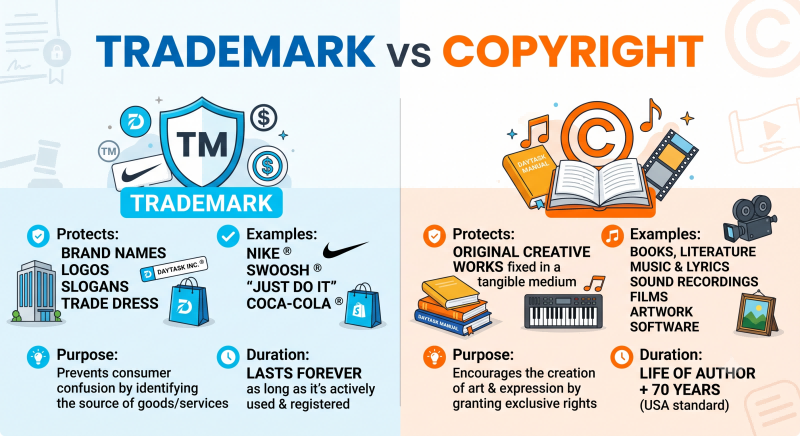
2. Overcoming Trademark Limitations via Cross-Category Protection
While trademark registration forms the cornerstone of brand protection, relying on trademarks alone presents two major vulnerabilities in China:
Class Restrictions vs. Universal Category Coverage
China classifies trademarks into 45 distinct categories. Most foreign companies initially register only in their core business classes (e.g., Class 9 for software or Class 25 for apparel).
The Risk: Bad-faith actors may hijack your logo by registering it across the remaining unfiled classes. When you expand your product lines, you may find your brand name blocked in other sectors.
-
Legal Leverage under Article 32: Copyright registration grants prior rights (在先权利) across all 45 classes. Under Article 32 of the China Trademark Law, if an infringer attempts to register your logo in an unfiled class, you can file an opposition or invalidation action based on your prior copyright.
Registration Timelines vs. Rapid Enforcement
Trademark applications with China National Intellectual Property Administration (CNIPA) often take several months to finalize. In contrast, copyright registration with the Copyright Protection Center of China (CPCC) offers a significantly faster review timeline, securing official ownership credentials during the trademark approval window.
3. E-Commerce Takedowns and China Customs IP Protection
For foreign companies operating without a local presence—such as a Wholly Foreign-Owned Enterprise (WFOE) —infringements frequently occur on digital platforms or within export supply chains. Under the Berne Convention, foreign works enjoy copyright automatically, but official local registration certificates are required for efficient enforcement.
-
Fast-Track E-Commerce Enforcement: On major online platforms (e.g., Taobao, Tmall, JD.com, Pinduoduo, Douyin, Amazon), platform compliance teams require clear proof of ownership. An official Work Registration Certificate (作品登记证书) enables rapid notice-and-takedown actions against unauthorized store logos, stolen product images, and counterfeit product listings.
-
China Customs IP Border Protection: Many overseas brands rely on Chinese manufacturers for OEM production. Under the Regulations of the People’s Republic of China on Customs Protection of Intellectual Property Rights, registering both your trademark and copyright with China Customs (GACC) allows customs officers to proactively seize unauthorized exports or counterfeit goods produced by rogue OEM factories.
4. Case Study: The Dual-Track Protection Strategy in Action
Case Background: Company A, a foreign outdoor gear brand with no physical entity in China, filed a trademark for its custom graphical logo under Class 25 (Apparel). During the examination period, a local bad-faith actor copied the logo to sell products on e-commerce platforms and filed a bad-faith trademark application for the same mark under Class 18 (Bags).
-
Enforcement Using Trademarks Alone: Because Company A’s Class 25 trademark was still under review and it held no Class 18 registration, platform takedown complaints were repeatedly rejected for “lack of clear title.” Trademark opposition procedures also faced lengthy delays.
-
The Turnaround via Copyright Registration: Company A rapidly secured a Copyright Registration Certificate for its logo as a work of fine art in China. With this certificate:
-
Platform Takedowns: Platforms removed all infringing product links within 48 hours based on visual copyright infringement.
-
Invalidating Bad-Faith Filings: Company A filed a successful invalidation action with the National Intellectual Property Administration (CNIPA) against the Class 18 squatted trademark based on Article 32 prior rights.
-
5. Simplifying Evidence and Long-Term Cross-Border IP Defense
Operating in China without a local corporate entity often presents complex evidentiary hurdles. Copyright registration resolves two major logistical challenges:
-
Eliminating Costly Cross-Border Legalization: Proving overseas creation dates for unfiled works typically requires expensive, time-consuming consular notarization and legalization (Apostille). A Chinese Copyright Certificate provides direct, prima facie legal proof of ownership before domestic courts and administrative bodies.
-
50-Year Protection Without Use Requirements: Trademarks must be renewed every 10 years and are vulnerable to non-use cancellation after three consecutive years (under Article 49). Corporate copyright protection lasts 50 years and remains valid regardless of commercial use in China, offering an enduring defensive shield.
On the battlefield of intellectual property protection, a trademark is your offensive sword, while a copyright is your all-around defensive shield.
Conclusion:
Registering a logo that matches your trademark as a work of fine art is not only a wise move to close legal loopholes at a minimal cost, but also an indispensable commercial moat for foreign enterprises expanding into the Chinese market without a local entity. GWBMA will continue to serve as a trusted official agent for global businesses, safeguarding your innovation and brand value in China every step of the way.
