


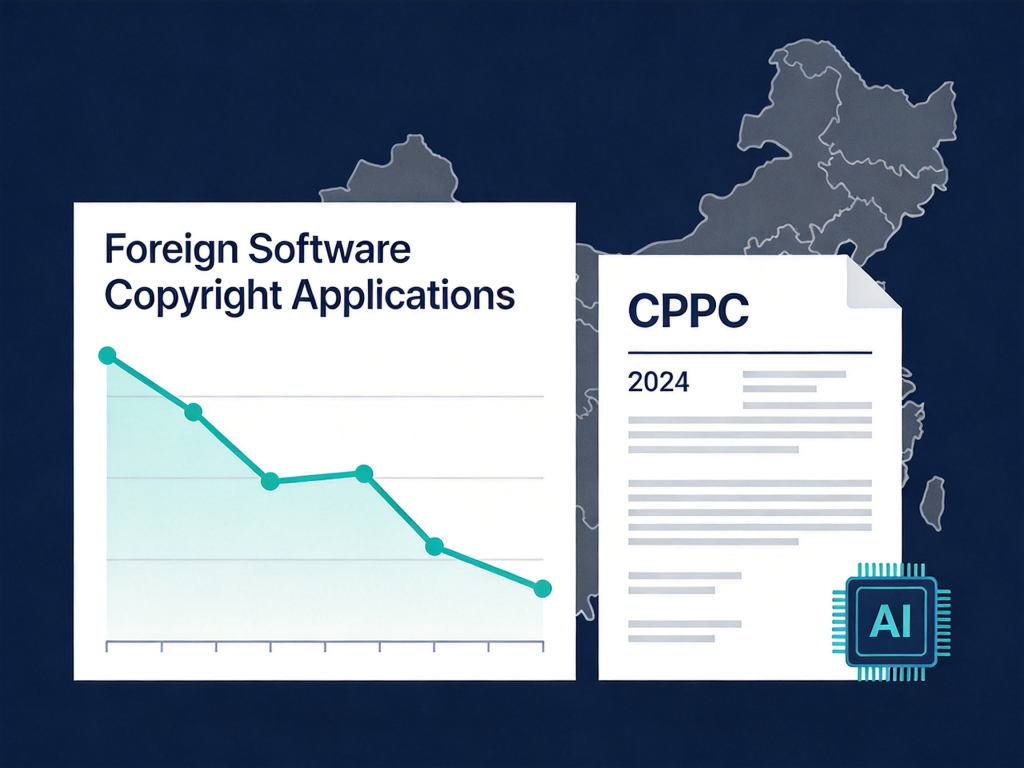
According to 2024 data from the China Copyright Protection Center (CPCC), the number of foreign applicants for Chinese computer software copyright registration dropped by 18.7% year-on-year, with an even steeper 27% decline in the AI software segment. This downward trend has raised concerns among global tech enterprises looking to enter the Chinese market, as software copyright registration remains the most cost-effective and legally recognized way to protect digital assets in China. This article breaks down the core reasons behind the declining number of foreign applicants, outlines official CPCC source program submission requirements, and provides actionable guidance for global developers looking to secure copyright protection for their software in China.
Key Drivers of Declining Foreign Software Copyright Applications in China’s AI Era
The drop in foreign applications stems from a combination of technical, regulatory, and geopolitical factors, all amplified by the rapid growth of AI software development over the past two years.
First, differing standards for assessing originality in AI-generated software have led to high rejection rates for foreign applicants. Under CPCC rules, software eligible for copyright registration must demonstrate clear human originality, meaning pure AI-generated content without human modification or oversight does not qualify for protection. Many foreign AI developers rely heavily on generative AI tools to write up to 70% of their code, but fail to document human-led design, modification, and integration work required to prove originality. Source: Beijing Municipal Bureau of Copyright data shows that 42% of AI software copyright applications from foreign entities were rejected in 2023, 21 percentage points higher than the rejection rate for domestic applicants. Many foreign developers, unaware of these strict originality requirements, abandon future applications after an initial rejection.
Second, strict source code submission requirements have raised concerns about trade secret exposure for foreign AI firms. The CPCC mandates specific formatting and content rules for source program submissions, which many foreign companies see as a risk to their core intellectual property, especially for AI models where algorithm code is the primary commercial asset. Official requirements state: The source program files shall be submitted in First and Last 30 consecutive pages, and if the pages less than 60 pages shall be submitted in full version. If there are primary and secondary modules, just submit the primary modules. And each page cannot be less than 50 lines. For AI developers working on large language models, predictive analytics tools, or proprietary AI algorithms, submitting 3,000 lines of core module code means exposing sensitive trade secrets that could be misused. A 2024 survey of US-based AI startups found that 68% of respondents avoided Chinese software copyright registration specifically due to source code submission requirements.
Third, geopolitical export control restrictions have barred many foreign tech firms from submitting code to Chinese authorities. For example, the US Export Administration Regulations (EAR) restrict the transfer of advanced AI technology, including core algorithm code, to Chinese entities. Source: U.S. Department of Commerce guidance issued in 2023 explicitly notes that submitting AI software source code to Chinese government agencies for copyright registration may violate EAR rules for firms operating in sectors like generative AI, semiconductor design, and cybersecurity. This has led almost 30% of US-based AI firms to halt all Chinese software copyright applications since 2023.
Fourth, many foreign firms are opting for alternative, lower-cost copyright protection frameworks instead of formal registration. As a signatory to the Berne Convention for the Protection of Literary and Artistic Works, China automatically grants copyright protection to works created in other member states, even without formal registration. Source: World Intellectual Property Organization. While automatic protection does not provide the same level of legal evidence in infringement cases as a formal registration certificate, many small and mid-sized foreign AI firms calculate that the cost and risk of CPCC registration outweigh the benefits, especially if they only have limited operations in the Chinese market.
Official CPCC Source Program Submission Requirements for Foreign Applicants
For foreign developers who still wish to secure formal Chinese software copyright protection, understanding and complying with CPCC submission rules is critical to avoiding rejection. In addition to the mandatory source program page and line count requirements outlined above, applicants must follow these additional rules:
| Submission Item | Standard Software Requirement | AI Software Special Requirement |
|---|---|---|
| Source Program Formatting | Printed on A4 paper, single-sided, with software name and version number in the header, page numbers in the top right corner, no sensitive or unlicensed third-party code | Same as standard, plus clear annotations marking any AI-generated code segments, along with records of human modification and integration work to prove originality |
| Supporting Documentation | One type of document (user manual, design specification, or operation guide), first and last 30 pages (full if <60 pages), ≥30 lines per page | Additional explanation of the AI model’s role in development, core algorithm logic, use case scenarios, and the extent of human developer control over the final product |
| Applicant Qualification Documents | Notarized and authenticated identity proof (business license for enterprises, passport for individuals), Chinese translation of all foreign-language documents with official translation company stamp | Same as standard, plus a signed declaration confirming that the submitted software does not contain technology restricted by export control rules in the applicant’s home country |
| Ownership Proof Documents | Contract or agreement for commissioned, cooperative, or task-assigned development projects, clearly stating copyright ownership | Same as standard, plus documentation of ownership for any pre-trained AI models or open-source components used in the software |
Foreign applicants can also request exceptional submission for source programs containing trade secrets, allowing up to 50% of the submitted code to be redacted with black slashes, as long as the remaining code still demonstrates the software’s originality. This option helps balance compliance requirements with trade secret protection for sensitive AI software.
How Foreign AI Developers Can Improve Copyright Application Success Rates
Despite the challenges, foreign AI developers can successfully secure Chinese software copyright protection by following these best practices:
First, document all human-led development work from the start of the project. Keep records of requirement documents, architecture design sketches, AI tool usage logs, and code modification records to prove that human developers played a leading role in creating the software. These records can be submitted as supplementary materials to address any originality concerns from CPCC reviewers.
Second, prepare source program files in strict compliance with CPCC rules. Ensure that core module code is submitted with the required page and line counts, mark any AI-generated segments clearly in comments, and use the exceptional submission option for any trade secret content to avoid exposing sensitive algorithm details. Working with a local professional service provider can help you identify and fix formatting issues before submission, reducing the risk of rejection due to technical errors.
Third, conduct a pre-submission compliance review to avoid conflicts with export control rules. Consult with legal teams to confirm that submitting the required source code to CPCC does not violate any export regulations in your home country. For high-risk AI technologies that cannot be submitted, consider alternative protection strategies such as patent registration for core algorithms or trade secret protection for internal use tools.
Fourth, leverage professional registration agencies with experience working with foreign applicants. Local agencies are familiar with CPCC review standards, can help with document translation and notarization, and can communicate directly with reviewers to resolve any questions during the application process, cutting down processing time by up to 30% on average.
Future Outlook for China’s Computer Software Copyright System in the AI Era
Chinese regulatory authorities are currently updating software copyright rules to adapt to the rapid development of AI technology, which may help reverse the decline in foreign applications in the coming years. Proposed changes include clearer guidelines for assessing originality in AI-assisted software, more flexible source code submission options for high-sensitivity AI systems, and a simplified application process for foreign applicants, including an English-language online application portal and reduced notarization requirements for eligible countries.
These updates are part of China’s broader push to attract global tech talent and innovation, as the country seeks to build a world-class intellectual property protection system. For foreign AI developers, these changes will make it easier and less risky to secure formal copyright protection for their products in the Chinese market, supporting long-term business growth and legal security.
Conclusion
The decline in foreign applicants for Chinese computer software copyright registration in the AI era is the result of a complex mix of regulatory differences, trade secret concerns, geopolitical restrictions, and shifting protection preferences. However, formal CPCC registration remains the most legally robust way to protect software assets in China, especially for firms planning long-term operations in the market. By understanding official submission requirements, documenting human originality, and following compliance best practices, foreign AI developers can successfully navigate the registration process and secure reliable protection for their digital assets. As China continues to update its copyright rules to accommodate AI innovation, the number of foreign applicants is expected to recover gradually in the coming years.
