


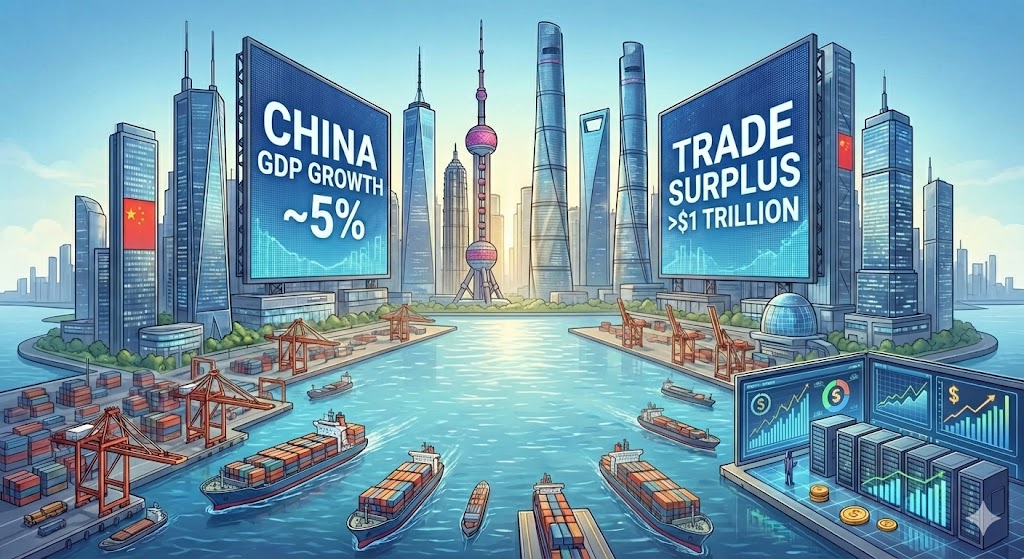
China’s economic headlines in 2025 paint a picture of resilience and scale: GDP growth hovering around the official 5% target, a historic trade surplus surpassing $1 trillion, and a stabilized Shanghai Composite Index following targeted stimulus. Yet beneath these milestones lies a stark reality: businesses grapple with shrinking margins, job seekers face a tightening hiring market, and AI’s rise intensifies the divide between growth and prosperity. This Economic Paradox—stellar economic data coexisting with widespread livelihood anxiety—exposes deep structural shifts reshaping China’s economy.
On the surface, the headline figures paint a picture of undeniable resilience and scale: GDP growth continues to hover around the official 5% target, anchored by a manufacturing engine that has generated a historic trade surplus surpassing $1 trillion. Yet, these formidable macroeconomic markers belie a more complex underlying reality. This article offers a comprehensive analysis of China’s Economic Paradox—exploring how record-breaking external performance coexists with internal structural shifts, and what this divergence means for the future of the global economy.
China’s Economic Milestones: Breaking Records in GDP, Trade, and Markets
By all traditional metrics, China’s economy is thriving. The National Bureau of Statistics reported a 5% GDP expansion in 2024, outpacing most major economies and exceeding the government’s 4.5% target. This growth was fueled by a robust export sector, which shattered records with a $1 trillion trade surplus—the first time in history China’s trade balance has crossed this threshold, according to China’s Ministry of Commerce. Meanwhile, domestic markets rallied: the Shanghai Composite Index, a benchmark for A-share performance, climbed 18.41%, driven by tech and green energy stocks.
These gains reflect strategic policy support, including targeted stimulus for high-tech industries and infrastructure investment. Foreign direct investment (FDI) also played a role, with multinationals continuing to bet on China’s manufacturing and consumer base, as highlighted in Foreign Investment in China: The Importance in the Post-pandemic Era. Yet for ordinary Chinese, these macroeconomic wins feel increasingly disconnected from daily life.
Profitless Prosperity: The Corporate Struggle Behind China’s Economic Paradox
While revenue charts point upward, the underlying profitability of Chinese enterprises tells a different story. A phenomenon often described as “involution” (or neijuan) has led to aggressive price wars across key sectors—from electric vehicles to e-commerce. To maintain the export momentum that fueled the $1 trillion surplus, manufacturers have slashed prices to historic lows, sacrificing margins for market share. This “profitless prosperity” creates a dangerous feedback loop. Although factory output is high, corporate cash reserves remain tight. The Producer Price Index (PPI) has hovered in negative territory for much of 2024 and 2025, signaling persistent industrial deflation. For businesses, this means that despite record revenues, there is little capital left for expansion or, crucially, for increasing headcount, directly feeding into the labor market stagnation.
The Employment Crisis: PMI Data Signals a Decade of Difficulty
The most troubling indicator of this disconnect lies in employment data. The National Bureau of Statistics’ Purchasing Managers’ Index (PMI) revealed that the employment sub-index hit a 10-year low in Q4 2024, with manufacturers and service providers scaling back hiring at an unprecedented rate. Youth unemployment, though officially unreported since 2023, is widely acknowledged to exceed 20%, while white-collar sectors like tech and finance are cutting roles amid AI-driven automation.
“We used to hire 50 new graduates annually; this year, we might hire 5,” says a HR director at a Shenzhen-based electronics firm, requesting anonymity. “AI tools now handle data analysis and customer service—roles that once absorbed entry-level talent.” This trend mirrors broader shifts: a 2024 NBS survey found 42% of manufacturers plan to replace 10%+ of low-skilled jobs with automation by 2026.
The Wealth Effect: How Real Estate Deepens China’s Economic Paradox
Compounding the employment friction is a significant shift in consumer psychology, driven largely by the recalibration of the property market. For decades, real estate accounted for roughly 70% of Chinese household wealth. As property valuations stabilize at lower levels in 2025 to curb speculation, the resulting “negative wealth effect” has prompted a sharp contraction in discretionary spending. Retail sales data reflect this caution, growing at a significantly slower pace than GDP. Consumers are prioritizing savings over spending, shifting away from luxury goods toward value-based purchases. This tepid domestic demand forces companies to rely even more heavily on exports, further widening the gap between China’s massive production capacity and its internal consumption power.
AI’s Double-Edged Sword: Productivity Gains vs. Job Displacement
Artificial intelligence is exacerbating the growth-employment gap. While AI boosts productivity—Chinese tech giants like Alibaba and Baidu report 30%+ efficiency gains in logistics and content moderation—it also eliminates jobs faster than new roles emerge. A Chinese AI industry report estimates that for every 1 job created in AI development, 5-7 positions are automated in sectors like retail, banking, and manufacturing.
Small and medium-sized enterprises (SMEs), which employ 80% of China’s workforce, face the brunt of this disruption. “AI tools from big tech firms let competitors undercut our prices, but we can’t afford the same technology,” explains a Hangzhou-based textile exporter. This pressure is reflected in SME PMI, which has lingered below the expansion threshold (50) for six consecutive months, signaling contraction.
Structural Shifts: Why Growth Isn’t Translating to Livelihoods
The root of China’s paradox lies in economic restructuring. GDP growth is concentrated in capital-intensive sectors—semiconductors, EVs, and renewable energy—that create few jobs relative to output. Meanwhile, labor-intensive industries like textiles and construction, once employment engines, are shrinking due to automation and property market slumps. The result: a “jobless growth” phenomenon where wealth accumulates at the top, while median incomes stagnate.
Social safety nets are also struggling to keep pace. Despite reforms outlined in Social Insurance in China: A Comprehensive Guide, unemployment benefits cover less than 20% of job seekers, and retraining programs for displaced workers remain underfunded. This leaves millions caught between outdated skills and an AI-driven job market.
Conclusion:
Addressing China’s economic paradox requires coordinated action. Policymakers are already pivoting: the 2025 “Digital Employment Initiative” aims to train 20 million workers in AI-adjacent skills, while tax breaks for SMEs adopting human-centric tech could slow job losses. For businesses, the path forward lies in reskilling employees and integrating AI as a complement to, rather than a replacement for, human labor.
