

As more global brands enter the Chinese market, English trademark applications have surged in recent years. However, many foreign applicants are unaware that using abusive English terms can lead to trademark rejection in China under the strict enforcement of the Trademark Law. Any mark deemed harmful to socialist moral standards or having adverse social impacts will be refused immediately, even if the terms are considered niche or playful in other jurisdictions. This guide breaks down CNIPA’s rules, common rejection cases, and best practices to avoid costly refusals when registering an English trademark in China.
Why Does CNIPA Reject Abusive English Trademarks?
The primary legal basis for the rejection of trademark registration with abusive English terms in China is Article 10(1)(8) of the Chinese Trademark Law, which explicitly prohibits signs that are harmful to socialist moral风尚 or have other adverse social impacts from being used as trademarks. This rule applies equally to Chinese, English, and all other language marks, as CNIPA’s examiners are required to verify the full meaning of any foreign-language term submitted for registration, including slang, regionalisms, and offensive connotations. Source: China National Intellectual Property Administration
A landmark 2019 case illustrates this rule: U.S.-based Lings Technology Co. applied to register the mark “ROUGHNECK” for protective gloves, arguing the term was a niche American slang term unfamiliar to most Chinese consumers. However, CNIPA examiners found the word translates to “rude, aggressive, uncivilized person” in standard dictionaries, a meaning with negative connotations that contradicts public moral standards. The Beijing High People’s Court upheld the Trademark rejection, confirming that even niche offensive terms are subject to refusal. Source: People’s Daily IP Channel
Unlike some Western jurisdictions that have loosened restrictions on “scandalous” marks in the name of free speech, China’s trademark system prioritizes public interest and cultural sensitivity, making it critical for applicants to vet all English terms carefully before filing. Understanding these rules is the first step to avoiding unnecessary delays and costs in your Trademark Registration in China process.
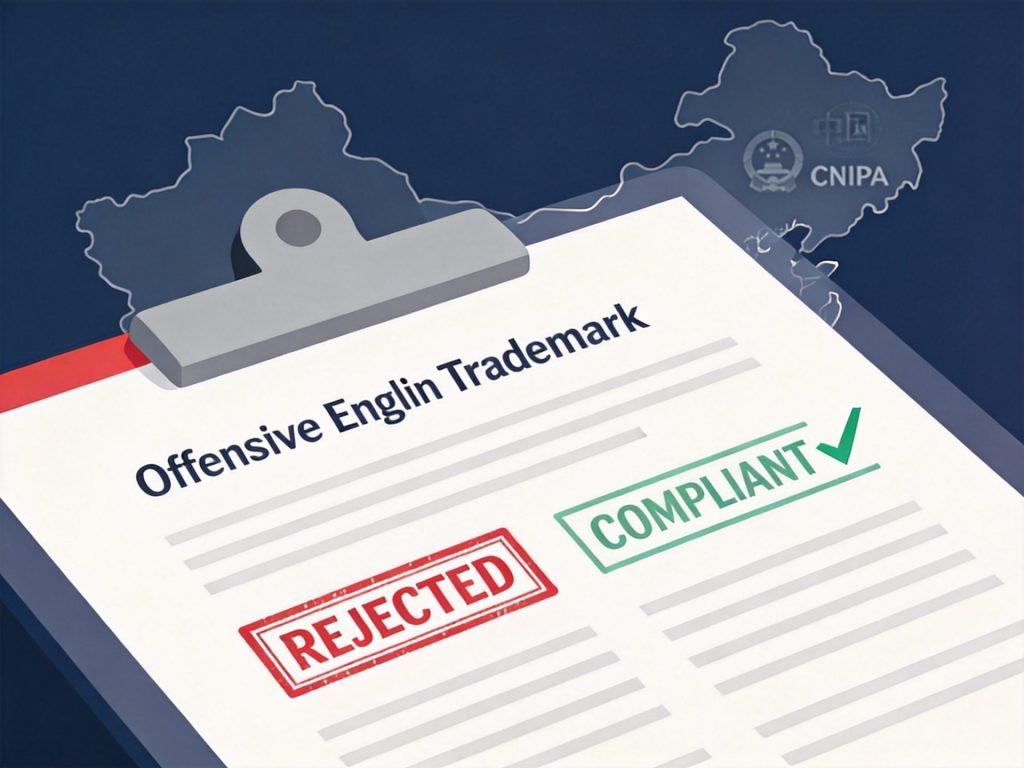
Common Abusive English Terms That Get Automatic Trademark Rejection
CNIPA maintains a zero-tolerance policy for any English term with vulgar, discriminatory, insulting, or morally inappropriate connotations, leading to automatic rejection of trademark registration with abusive English terms for the following categories of content. Below is a non-exhaustive list of commonly refused terms and their rejection grounds:
| English Term | Offensive Meaning | Rejection Grounds |
|---|---|---|
| Asshole / Ass | Vulgar insult referring to a contemptible person or obscene body part reference | Explicit vulgar content that violates public order and good morals |
| Roughneck | Rude, aggressive, uncivilized person | Negative connotation contradicts socialist moral standards |
| Hustler | Pimp, swindler, sex worker (widely recognized secondary meaning) | Potential adverse social impact, even if a non-offensive primary meaning exists |
| Negro / Honky | Racially offensive terms targeting Black and white people respectively | Discriminatory content that violates ethnic equality principles |
| Fuck / Fvck / Fuk / FUCT | Highly vulgar swear word, including intentional misspellings designed to avoid detection | Explicitly offensive content that harms public moral standards |
| Fancy Lady | Slang term for mistress or sex worker | Adverse social impact that contradicts mainstream moral values |
| Formosa | Colonial-era derogatory term for Taiwan, China | Harmful to national sovereignty and public sentiment |
Notably, CNIPA also rejects terms that are phonetically similar to abusive English terms, even if the spelling is technically different, if examiners determine the association is obvious to relevant consumers. For example, a mark spelled “FOOK” would face scrutiny due to its phonetic similarity to a common vulgar English term, even if the applicant claims it is a transliteration of a non-English word. Source: Shanghai Municipal Administration for Market Regulation
Knowing which terms are likely to be refused is helpful, but understanding CNIPA’s formal examination criteria for offensive marks will help you vet your brand name more effectively before filing.
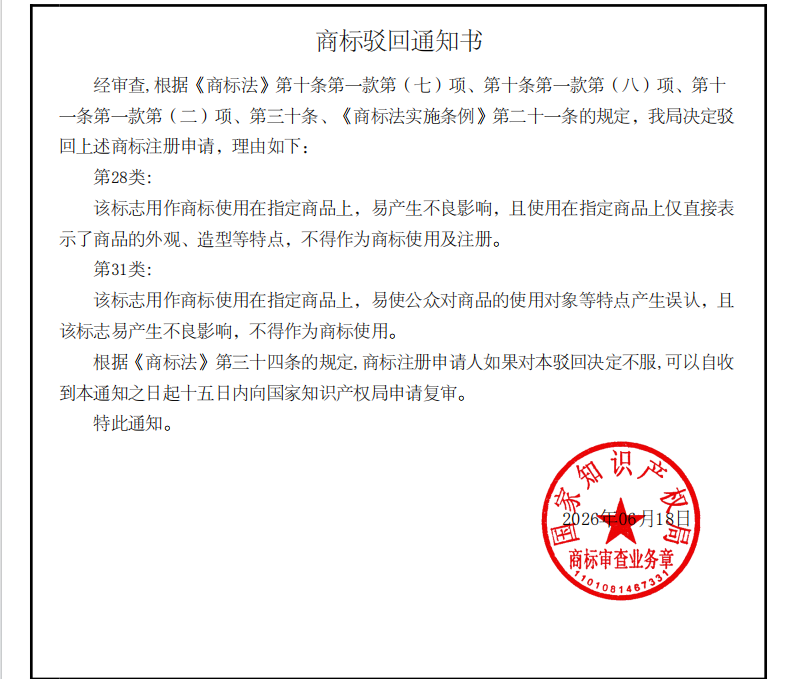
Why Foreign Applicants Face Higher Trademark Rejection Risks
Foreign trademark applicants often encounter unexpected rejections due to gaps in their understanding of China’s trademark legal framework, which operates very differently from systems in the U.S., EU, and other common law jurisdictions. The most common pain points include a lack of awareness of China’s first-to-file system, which grants trademark rights to the first party to submit an application regardless of prior use in other markets, and unfamiliarity with CNIPA’s strict rules around prohibited content, classification, and document formatting. Many foreign applicants also underestimate the risk of translation-related issues, such as brand names with unintended negative connotations in Chinese or phonetic similarities to existing registered marks. Source: International Trademark Association (INTA) These gaps often lead to direct, avoidable rejections that can delay brand entry into the Chinese market by 6 to 12 months, or even result in permanent loss of brand rights to trademark squatters. Working with an experienced local agent eliminates these knowledge gaps and ensures your application adheres to all CNIPA requirements from the first submission.
Key Criteria for Selecting a Qualified Chinese Trademark Agent
Not all trademark agents in China are equally equipped to support foreign applicants and avoid direct trademark rejection in China. Choosing a licensed, experienced agent is the foundation of a successful application. Below is a comparison of critical differences between qualified professional agents and unqualified low-cost providers that often lead to rejected applications:
| Criteria | Licensed Professional Agent | Unqualified Low-Cost Agent |
|---|---|---|
| CNIPA Registration | Officially registered, verifiable on the CNIPA public database | No official registration, operates without legal authorization to file trademarks |
| Pre-application Search | Comprehensive cross-subclass similarity check covering all relevant goods and services | No search or only basic surface-level checks that miss conflicting marks in subclasses |
| Classification Expertise | Deep understanding of China’s unique subclass system beyond the standard Nice Classification | Uses generic Nice Classification headings that do not comply with CNIPA subclass rules |
| Document Compliance | Ensures notarized Power of Attorney (POA), translations, and trademark specimens meet all CNIPA formatting rules | Submits incomplete, incorrectly translated, or improperly formatted documents that trigger automatic rejection |
| Post-submission Support | Provides real-time status updates, rejection appeal strategy, and representation if objections arise | No support after submission, ignores client inquiries when applications are rejected |
When evaluating agents, prioritize firms with a proven track record of working with foreign clients, fluent English support, and transparent pricing that includes all pre-application services and basic post-submission support. Avoid providers that offer extremely low fees below market average, as these almost always cut corners on critical pre-application checks that prevent rejection. Once you have selected a qualified agent, they will implement a series of proactive measures to eliminate common rejection risks before your application is submitted.
What to Do If Your English Trademark Is Rejected for Abusive Content
If you receive an official refusal citing Article 10(1)(8) as the grounds for rejection of trademark registration with abusive English terms, your response strategy will depend on the specific circumstances of your application:
First, if the mark does in fact contain an abusive or offensive term, it is almost always advisable to abandon the application or modify the mark, as Article 10 is a mandatory prohibition that applies even if the mark has acquired distinctiveness through use. There are very few exceptions to this rule, and appeals are rarely successful for clearly offensive terms.
However, if the term has multiple meanings and the offensive interpretation is not the most common, or if the term is a transliteration of a non-English word with no intended offensive meaning, you may file a review application with the CNIPA Trademark Review and Adjudication Board. To succeed, you will need to submit substantial evidence proving that the relevant public primarily associates the mark with a non-offensive meaning, such as consumer surveys, evidence of use in other markets, or expert linguistic opinions. For example, a mark that is a transliteration of a traditional Chinese phrase with a positive meaning may be approved even if it has a minor offensive connotation in niche English slang, if you can prove the primary association for Chinese consumers is positive.
Navigating the review process for this type of Trademark rejection is complex, so it is highly recommended to work with a Licensed Trademark Agent in China who has experience with offensive mark appeals to maximize your chances of success.
Proactive Steps to Avoid Abusive English Trademark Rejection
The best way to avoid the rejection of trademark registration with abusive English terms is to conduct thorough due diligence before filing your application, rather than trying to appeal a refusal after the fact. Follow these steps to reduce your risk:
1. Conduct a full meaning audit of your proposed English mark: Consult multiple dictionaries, slang databases, and cultural references to identify any possible offensive, discriminatory, or vulgar connotations, even if they are niche or regional. Pay special attention to slang meanings that may not appear in standard dictionaries.
2. Avoid intentional misspellings of offensive terms: Many applicants try to use modified spellings of vulgar terms to “trick” examiners, but CNIPA regularly rejects marks like “FVCK” or “FUK” that are obviously intended to reference abusive terms, even if the spelling is not exact.
3. Prepare a meaning explanation for transliterated marks: If your English mark is a transliteration of a Chinese, brand name, or other non-English term, submit a formal explanation of the intended positive meaning with your application to prevent examiners from associating it with an offensive English term.
4. Work with a local trademark agent for pre-filing review: Local agents are intimately familiar with CNIPA’s examination standards and can identify potential issues with your English mark before you file, saving you the time and cost of a trademark rejection in China. They can also advise you on whether a potentially ambiguous mark is likely to be approved or if you should modify it to reduce risk.
By following these steps, you can align your trademark application with the requirements of China’s Trademark System and avoid unnecessary delays or refusals.
How Agents Handle Provisional Refusals to Save Your Application
If your application receives a provisional refusal notice from CNIPA, your agent will first conduct a full analysis of the refusal grounds to determine the most effective response strategy. Refusals fall into two categories: absolute grounds, such as lack of distinctiveness or prohibited content, and relative grounds, such as similarity to a prior registered mark. For absolute grounds refusals, agents can help you gather evidence of acquired distinctiveness, such as sales data, advertising records, and consumer survey results proving that your mark is widely recognized by Chinese consumers and functions as a source identifier for your goods or services. For relative grounds refusals based on conflicting prior marks, agents can pursue multiple strategies to overcome the objection: filing a non-use cancellation against the prior mark if it has not been used in commercial activity in China for three or more years, negotiating a coexistence agreement or consent letter with the owner of the prior mark, or narrowing the scope of your goods and services to avoid overlap with the conflicting mark. A prominent example of this strategy is the 2021 Tommy Hilfiger case, where the brand’s stripe logo was initially rejected for similarity to the national flag of Yemen. Their legal team successfully obtained a trademark registration for the mark in Yemen, proving the Yemeni government consented to its use, and the Beijing High Court overturned the CNIPA refusal. Agents ensure all response materials are submitted within CNIPA’s strict 30-day deadline for responding to refusal notices, and can take advantage of the 3-month supplementary evidence window to strengthen your case. If CNIPA upholds the refusal after review, agents can also represent you in appealing the decision to the Beijing Intellectual Property Court for further review. Source: World Intellectual Property Organization (WIPO)
Conclusion:
In summary, avoiding trademark rejection in China requires a clear understanding that the CNIPA strictly blocks applications with abusive English terms to protect public order, moral standards, and consumer interests. While jurisdictions like the U.S. have loosened rules on scandalous marks in recent years, China maintains zero tolerance for offensive, discriminatory, or vulgar content in trademarks, regardless of whether the terms are in Chinese or English. By conducting pre-filing due diligence, verifying all potential meanings of your English mark, and working with a qualified local agent, you can avoid unnecessary rejections and secure valid trademark protection for your brand in the Chinese market.
