

For global brands expanding into the U.S. and Chinese markets, word mark trademark registration is one of the most cost-effective ways to protect core brand identity, prevent infringement, and build consumer recognition. While both the U.S. Patent and Trademark Office (USPTO) and China National Intellectual Property Administration (CNIPA) oversee word mark applications, their regulatory frameworks differ significantly, and non-compliance with CNIPA’s specific filing rules can lead to costly delays or outright rejections. This guide breaks down key similarities, differences, and official CNIPA specifications for Word Mark Trademark Registration in China to help you streamline your filing process.
Core Consistencies Between China and the U.S. Word Mark Trademark Registration
Despite operating under distinct legal systems, CNIPA and USPTO share core foundational goals for word mark protection, creating a baseline of alignment for global applicants.
First, both agencies require word marks to demonstrate distinctiveness to qualify for registration. Generic or descriptive terms that directly refer to the product or service offered (e.g., “Coffee Shop” for a café business) will be rejected by both offices, as they cannot be exclusively owned by a single entity. Second, both offices conduct prior art searches to reject applications that are confusingly similar to already registered or pending marks, to avoid consumer confusion. Third, both use the international Nice Classification system to categorize goods and services, with 45 total classes covering all commercial categories. Finally, both agencies offer a public opposition period after preliminary approval, allowing third parties to challenge applications that infringe on their existing rights. Source: U.S. Patent and Trademark Office
These shared rules mean that a word mark deemed registrable in one market will often meet core eligibility requirements in the other, as long as you adjust for region-specific procedural rules.
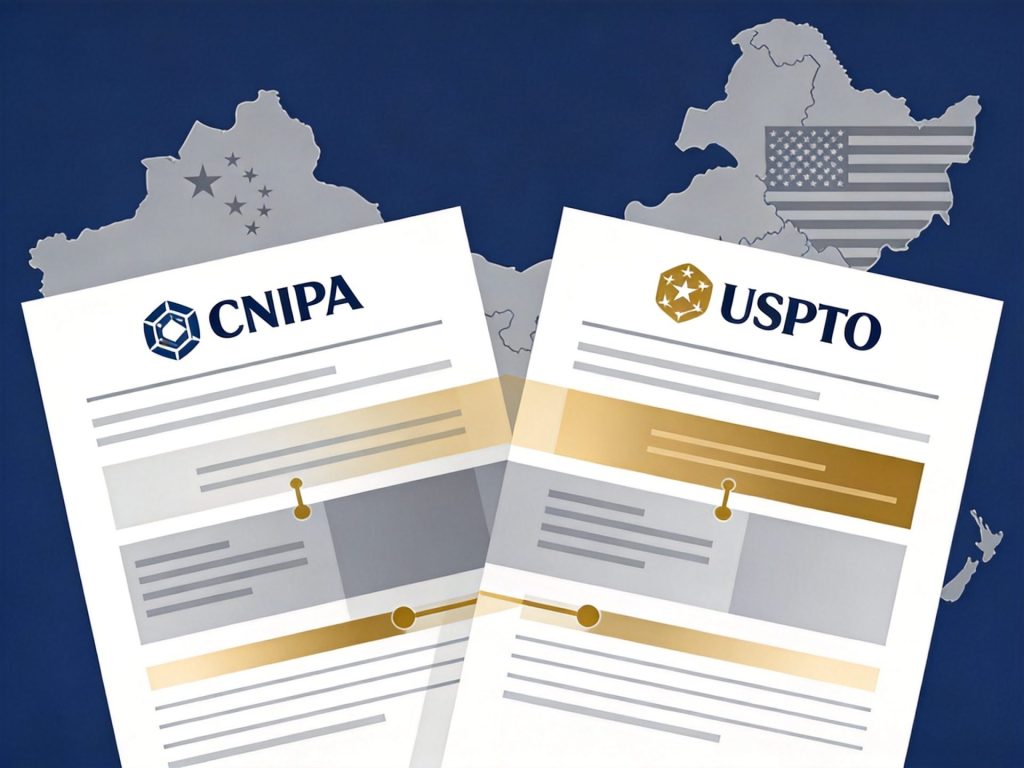
Key Differences in Word Mark Trademark Registration Between China and the U.S.
The most impactful differences between Chinese and U.S. word mark registration fall into four core categories, as outlined in the comparison table below:
| Category | CNIPA (China) | USPTO (U.S.) |
|---|---|---|
| Ownership Principle | Strict first-to-file system: rights are granted to the first applicant to submit a formal application, regardless of prior use | First-to-use system: rights are granted to the first party to use the mark in commercial activity, even if another applicant files earlier |
| Format Consistency Requirement | 100% match required between the submitted word mark text description and uploaded image, including capitalization, font, and spacing. Minor discrepancies (e.g., “FlowerShop” in the application vs “flowershop” in the image) will lead to automatic rejection | Content match is prioritized; minor capitalization or formatting differences are not considered grounds for rejection, as long as the text content is identical |
| Use Evidence Requirement | No use evidence required at the time of application; marks may be filed purely to reserve rights | Applicants must submit proof of commercial use, or an “intent to use” declaration, to complete registration |
| Maintenance Requirements | Only renewal required every 10 years; marks may be canceled if unused for 3 consecutive years, but no regular use declarations are required | Use declarations with evidence required 5-6 years after registration, and again at each 10-year renewal, to maintain validity |
These differences mean that brands must implement separate filing strategies for each market, with a particular focus on strict format compliance for CNIPA applications.
Official CNIPA Word Mark Trademark Registration Specifications You Must Follow: 8 Standard Description Formats
CNIPA has published clear, mandatory requirements for word mark applications, including image specifications and standardized trademark description formats. Non-compliance with these rules accounts for over 40% of initial word mark application rejections, according to 2024 CNIPA data.
First, all uploaded word mark images must meet two non-negotiable requirements: the image must be high-resolution (minimum 300 DPI, clear and unblurred), and may not contain any extra black lines, borders, watermarks, or unrelated elements outside of the mark itself. Second, the trademark description included in your application must follow one of the standardized formats below, based on your mark type:
- Pure word mark: “The trademark text is [Exact Word Mark Text].”
- Word mark with designated color: “This trademark uses designated colors, and the trademark text is [Exact Word Mark Text]”
- Combined word and graphic mark: “This trademark is a combination of text and graphics, and the trademark text is [Exact Word Mark Text].”
- Combined word and graphic mark with designated color: “This trademark uses designated colors and is a combination of text and graphics, and the trademark text is [Exact Word Mark Text]”
- Word mark with Chinese characters and pinyin: “The Chinese text of this trademark is [Chinese Characters], and the corresponding pinyin is [Pinyin Text]”
- Letter mark with no inherent meaning: “The trademark name is [Letter Mark Text], which has no specific meaning.”
- Mark containing seal script characters: You must include the simplified Chinese equivalent of all seal script characters in the trademark description, along with the standard mark format
- Mark containing ethnic minority languages or foreign languages: “This trademark consists of Chinese and [Ethnic Minority/Foreign Language], the Chinese text is [Chinese Text], the [Ethnic Minority/Foreign Language] text is [Non-Chinese Text], and its meaning is [Clear Translation of Non-Chinese Text].”
For complex combined marks, a complete description example would be: “This trademark uses designated colors, and consists of the text ‘Fluid Research’ and a graphic. ‘Fluid’ means a substance that flows freely, ‘Research’ means systematic investigation, and the preceding graphic indicates the flow direction of glue.” Source: China National Intellectual Property Administration
You must ensure that all text in the trademark description exactly matches the text in your uploaded image, including capitalization, spacing, and spelling, to avoid rejection.
Common Pitfalls to Avoid When Filing a Word Mark Trademark with CNIPA
Even experienced global trademark applicants often fall foul of avoidable mistakes when filing CNIPA word mark applications, leading to 3-6 month delays or total application loss.
The most common error is mismatched capitalization or formatting between the application text and the uploaded image. For example, a European fashion brand filed a word mark application for “LEAFLUX” in 2024, but uploaded an image of the mark in all lowercase “leaflux”. CNIPA rejected the application immediately due to the mismatch, forcing the brand to refile and lose its earlier priority date, during which a third party filed a nearly identical mark for similar goods. Another common mistake is including extra black lines or borders around the mark image, which CNIPA interprets as part of the mark, leading to a discrepancy with the written description.
Other frequent errors include failing to disclose designated colors, not providing translations or meanings for foreign language marks, and omitting simplified Chinese equivalents for seal script characters. To avoid these pitfalls, always cross-verify your image and application text three times before submission, and work with a local licensed trademark agent who is familiar with CNIPA’s latest requirements.
Actionable Tips for Global Brands Filing Word Mark Trademark in Both Markets
To maximize your chances of successful word mark registration in both China and the U.S., implement the following coordinated strategy:
- File applications simultaneously in both markets as soon as you finalize your brand name. This secures your first-to-file priority in China while you build evidence of commercial use for your USPTO application.
- For CNIPA applications, create your mark image first, then copy the text exactly as it appears in the image for your application description, including capitalization and spacing. Ensure the image has no extra elements and is high-resolution.
- Hire local experts for each market: a licensed U.S. trademark attorney to handle USPTO use evidence requirements, and a CNIPA-registered trademark agent to navigate China’s specific formatting and description rules.
- Set up regular trademark monitoring in both markets to detect squatting or infringement attempts early, especially in China, where first-to-file rules make pre-launch squatting a common risk.
By following these steps, you can minimize rejection risks and secure consistent word mark protection across both of the world’s largest consumer markets.
Conclusion:
In summary, while China and the U.S. share core goals for word mark trademark protection, their procedural rules differ significantly, particularly around ownership principles and format compliance. For CNIPA applications, strict adherence to official image requirements and standardized trademark description formats is non-negotiable to avoid costly rejections. By tailoring your filing strategy to each market’s unique rules and partnering with local experts, you can build a robust global trademark portfolio that protects your brand identity long-term.
GWBMA is a professional agency that has built a complete trademark registration system specifically for foreign clients.
With a robust automation platform and a fully bilingual team, we deliver end-to-end services with clarity and confidence.
To us, a POA is not just a document — it’s the start of the safest path for your brand in China.
